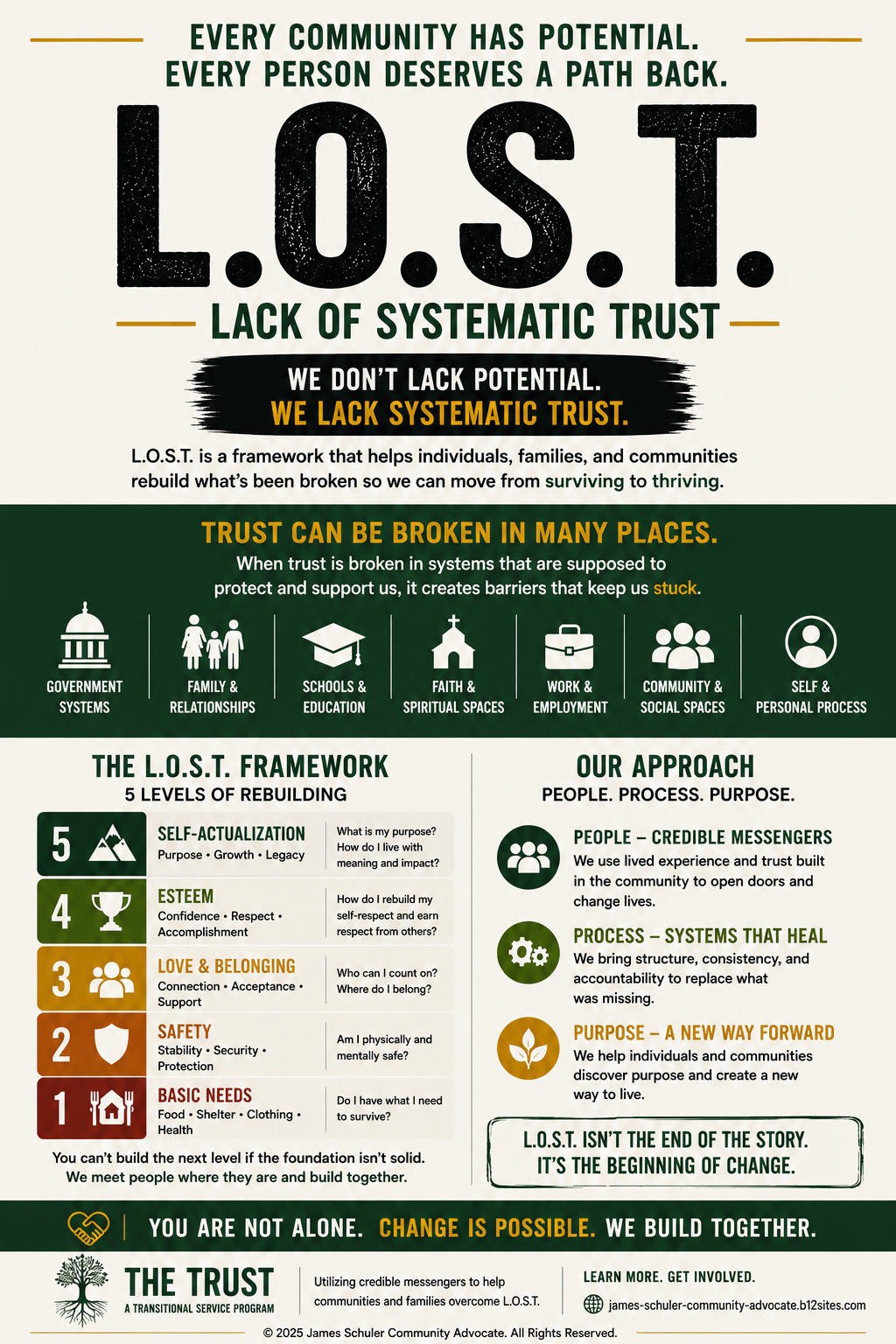
I created L.O.S.T. (Lack of Systematic Trust) after decades of lived experience, community advocacy, youth development, family engagement, and work within the justice system. Throughout that journey, I kept seeing the same pattern: people often wanted to change, but something deeper kept getting in the way.
L.O.S.T. is my framework for understanding why individuals, families, and communities struggle to move forward, even when opportunities, services, and support are available.
Many people are told they have "trust issues." I believe we should ask a different question:
What if the problem isn't simply trusting people? What if trust has been repeatedly broken by the systems, processes, and experiences that shape our lives?
What I Mean by Systematic Trust
When I talk about systematic trust, I'm referring to the confidence we develop through repeated experiences with people, institutions, and everyday processes.
When those experiences are consistent, fair, and dependable, trust grows.
When they are inconsistent, harmful, or repeatedly disappointing, people naturally adapt to survive. Those survival strategies may protect us in the moment, but they can also become barriers to growth later in life.
I've seen this happen through experiences with:
Family relationships
Schools and education
Government systems
Healthcare
Employment
Faith communities
The justice system
Neighborhoods and communities
Even our own habits, beliefs, and decision-making processes
These experiences shape how we see ourselves, how we relate to others, and what we believe is possible for our future.
My Approach
I don't begin by asking, "Who's to blame?"
Instead, I ask:
What experiences shaped this way of thinking?
What systems reinforced it?
What strengths already exist?
How can trust be rebuilt with intention and integrity?
I believe understanding must come before judgment. Real change begins when we seek to understand the whole person, not just the behavior.
Rebuilding Trust
Through the L.O.S.T. framework, I focus on rebuilding trust from the ground up.
I believe lasting change starts by helping people:
Meet their basic needs.
Create physical and emotional safety.
Build healthy relationships.
Develop confidence and self-respect.
Discover purpose and contribute to their communities.
As trust grows, people become better equipped to make intentional decisions, strengthen their families, and become positive leaders in their communities.
Who L.O.S.T. Is For
Although L.O.S.T. grew from my own experiences and work, I designed it to be useful in many settings, including:
Youth development
Family support
Schools
Reentry and justice-involved populations
Community organizations
Faith communities
Government agencies
Businesses and employers
Leadership development
Every person's story is different, but the need for trust is universal.
My Vision
My vision is simple: I want to help individuals, families, organizations, and communities rebuild trust where it has been broken.
To me, L.O.S.T. is more than a concept or a theory. It is a practical framework that helps people understand how trust is built, how it is lost, and how it can be restored through consistent actions, healthy relationships, and trustworthy systems.
I believe that when people begin to trust the processes around them, and trust themselves to move forward, they create stronger families, healthier communities, and opportunities for future generations.
Because when trust grows, people grow. And when people grow, communities thrive.